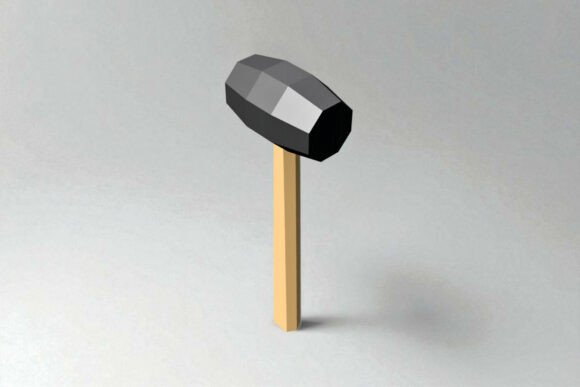
Mallet Hammer - 3d Papercraft
The Mallet Hammer - 3d Papercraft is a creative and practical tool that transforms flat paper into a detailed, three-dimensional model. Designed for enthusiasts and professionals alike, it offers a hands-on approach to crafting, blending artistry with precision. This papercraft kit is ideal for those looking to add a tactile element to their projects, whether for personal enjoyment, educational purposes, or as part of a larger creative workflow.
Unlike traditional 3D models that require advanced skills or specialized equipment, the Mallet Hammer - 3d Papercraft simplifies the process. It provides all necessary templates in multiple formats—PDF, DXF, EPS, PNG, and JPG—ensuring compatibility with various design and printing tools. This flexibility makes it accessible for users at different skill levels, from beginners to experienced crafters.
Integrating Mallet Hammer - 3d Papercraft into Workflows
The Mallet Hammer - 3d Papercraft can be used at multiple stages of a project, offering value before, during, and after key phases. Before starting a physical build or prototype, it serves as a planning aid, allowing users to visualize the final outcome. During the development phase, it can act as a reference or a physical mockup for testing ideas. After completion, it becomes a functional or decorative piece that enhances the overall result.
For instance, in product design, the Mallet Hammer - 3d Papercraft can help designers communicate concepts to stakeholders. In education, it supports hands-on learning by turning abstract ideas into tangible models. For entrepreneurs, it offers a low-cost way to present prototypes or promotional materials without the need for expensive manufacturing.
Preparation and Setup
To begin, users need basic crafting supplies: a colored printer, glue, scissors, a craft knife, a scorer or bone folder, a non-working ballpoint pen, a ruler, and A4 or letter-sized cardstock paper. The preparation phase involves printing the templates at full size, ensuring accuracy and clarity. Once printed, the next step is cutting out the pieces, which requires careful attention to detail to maintain the integrity of the design.
Scoring the paper along designated lines is crucial for creating clean folds. A scorer or bone folder helps achieve precise bends, while a non-working ballpoint pen can be used to create creases where needed. These steps ensure that the final model is sturdy and visually appealing.
Assembly Process
Assembling the Mallet Hammer - 3d Papercraft typically takes about an hour, making it a manageable project for most users. The process involves folding the paper along scored lines, aligning the pieces, and securing them with glue. Flaps on the templates are designed to fit together seamlessly, reducing the need for additional fasteners or adhesives.
Attention to detail during assembly ensures that the final product meets quality standards. Users should take their time to ensure each section is properly aligned and glued. This not only improves the appearance of the model but also enhances its durability. For those new to papercraft, practicing on smaller projects first can build confidence and improve technique.
Compatibility and Customization
The Mallet Hammer - 3d Papercraft is compatible with a wide range of design software and printing methods. The availability of multiple file formats allows users to customize the templates to suit their needs. For example, the DXF and EPS files can be imported into vector graphics programs for adjustments, while the PNG and JPG files are suitable for quick printing or digital use.
This flexibility enables users to adapt the design to different paper sizes, colors, or textures. Customizing the model can also enhance its functionality, such as adding labels, text, or decorative elements. By tailoring the papercraft to specific requirements, users can maximize its utility in their workflow.
Efficiency and Organization
Using the Mallet Hammer - 3d Papercraft efficiently requires organization and planning. Keeping all materials in one place, such as a dedicated crafting station, streamlines the process and reduces delays. Labeling templates and storing them in a folder or binder can also improve accessibility and reduce confusion.
For those working on multiple projects, maintaining a consistent workflow is essential. This includes setting aside specific times for crafting, using checklists to track progress, and reviewing completed models for quality. By integrating the Mallet Hammer - 3d Papercraft into a structured routine, users can achieve better results and minimize errors.
Quality Control and Long-Term Use
Ensuring the quality of the Mallet Hammer - 3d Papercraft involves careful attention to each step of the process. Checking that all pieces are cut accurately, folded correctly, and glued securely helps prevent issues later on. Users should also test the model after assembly to confirm that it functions as intended.
For long-term use, proper storage is important. Keeping the finished model in a dry, cool place protects it from damage and extends its lifespan. If the papercraft is part of a larger project, documenting the process and keeping notes can provide valuable insights for future reference. This practice supports continuous improvement and helps refine techniques over time.
Use Cases and Practical Applications
The Mallet Hammer - 3d Papercraft has diverse applications across different fields. In marketing, it can be used to create eye-catching displays or promotional materials that engage audiences. In education, it supports interactive learning by helping students understand complex concepts through physical models.
For hobbyists, it offers a rewarding way to express creativity and develop craftsmanship skills. In business, it can serve as a cost-effective alternative to traditional prototyping methods, allowing for rapid iterations and feedback. By leveraging the Mallet Hammer - 3d Papercraft in these contexts, users can enhance their productivity and achieve better outcomes.
Conclusion
The Mallet Hammer - 3d Papercraft is a versatile and practical tool that adds value to various workflows. Its ease of use, flexibility, and visual appeal make it a valuable asset for professionals and enthusiasts alike. By understanding how to integrate it into daily tasks, users can unlock new possibilities and improve their creative processes.
Whether used for planning, execution, or presentation, the Mallet Hammer - 3d Papercraft demonstrates the power of simple yet effective solutions. With the right approach, it can become a reliable part of any workflow, contributing to efficiency, quality, and innovation.